
Full specification
| Parameter | Value |
|---|---|
| Degrees of freedom | 7 |
| Reach | 892 mm |
| Mass per arm | 5 kg |
| Payload | 3 kg |
| Modules | RBV3 R48 / R58 / R68 |
| Control | CANopen / CAN-FD / EtherCAT |
| Torque sensor | Yes, every axis |
| Brake | Yes, power-off, every axis |
| Backdrive | Yes, with the brakes released |
Source: Crabnova HRV1 arm datasheet and RBV3 module configuration sheets. Figures verified November 2026 — confirm the exact variant against the datasheet issued with your order.
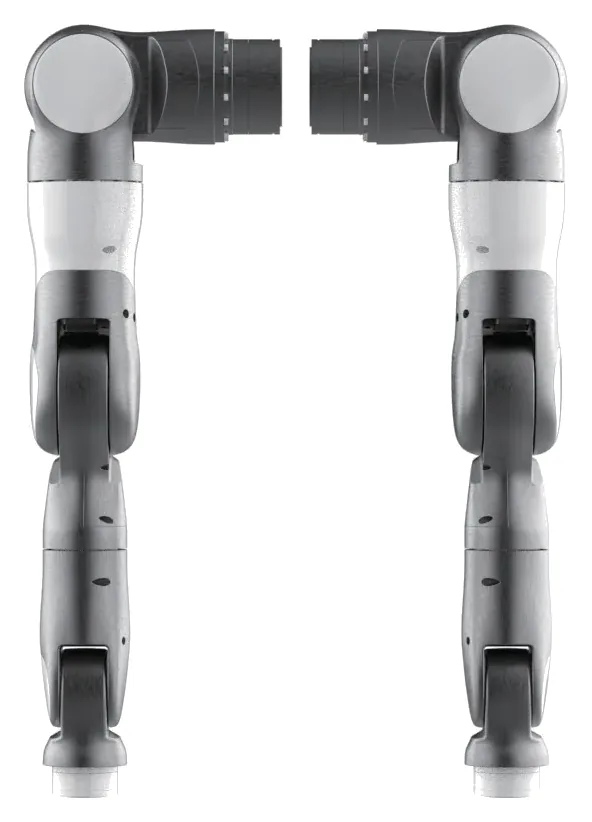
When this is the right choice
- Torque sensing on every axis. Force labels for the dataset, compliant control, and collision detection that actually works — three things the data-collection version cannot do.
- Power-off brakes. The arm holds position when disabled, which is what makes it usable on a deployed robot rather than only on a bench.
- EtherCAT in addition to CAN. A 7-axis arm at high rates wants EtherCAT; CANopen leaves little headroom once a hand and a camera are on the bus.
- Only 350 g more than the data-collection build per arm for a brake and a sensor on all seven axes.
When it is the wrong choice
- Higher cost per axis. The torque sensor and brake are the parts that make this roughly a third more expensive than the data-collection version.
- 5 kg per arm. Two of them plus a torso is a 10 kg upper body — plan the waist actuator accordingly.
- Brakes need releasing for hand-guiding. A backdrivable-only arm is quicker to position; here every manual move is a brake release.
Alternatives at a similar level
- Crabnova HRV1 15 kg force-control — 15 kg payload, 950 mm reach, 20 kg per arm
- Crabnova HRV1 3 kg data-collection — 892 mm reach, no brake or sensor, 4.65 kg
- Linker Arm H75 — 5 kg payload, ±0.027 mm, lighter at 8.25 kg total
Quote this model
Model, quantity and destination is enough to start — we come back with price, availability and the datasheet.
Crabnova HRV1 3 kg force-control FAQ
Is this the arm for a data-collection station?
If the dataset needs force labels or the policy will be trained on contact-rich tasks, yes. For pure kinematic demonstration the data-collection version does the same job for less.
Does the torque sensor replace a wrist F/T sensor?
No. Joint torque sensing gives you per-axis torque and good compliance, but a six-axis wrist sensor still does force/torque at the tool. Most labs use joint torque for control and a wrist sensor only when the task needs the full wrench.
How long does it take to ship?
Assembled to order from RBV3 modules; the quotation carries the date for the configuration.
Back to Crabnova (Juxiedrive) · arms & robot platforms · need a model that is not listed?