
What a capture station is made of
Three layers decide what your dataset looks like: the leader that records the human, the follower that replays it, and the end effector at the tip. We supply all three from one module family, so the follower arm, the hand and the glove share a control stack and a spare-parts list.
| Part | Role in the station | Key specs | Interface / power |
|---|---|---|---|
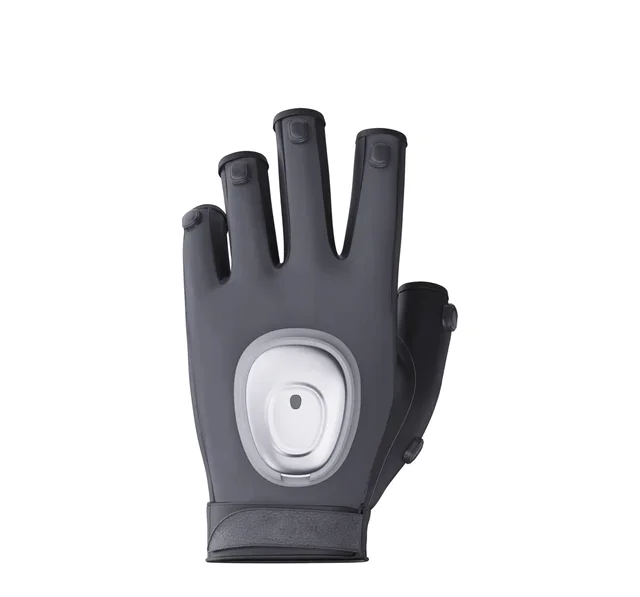
| Linker MCG glove | Leader — hand motion capture | 7 sensors per glove, ≤0.001° resolution, 0.1°/0.2° static accuracy | 700 mAh, 6 h, 600 Hz processing / 100 Hz output, 2.4 GHz |
| Linker FFG glove | Leader — hand capture with force feedback | 21 DOF, 16 potentiometers + 5 servos, 390 g, 0.08° accuracy | 3.5 kg·cm torque output, wired 100 Hz / wireless 30 Hz |
| Linker TA teleoperation arm | Leader — whole-arm pose | 14 DOF, 658 mm span, 1.4 kg, 12-bit absolute encoders | CAN 1 Mbps, 200 Hz sampling, chest-mounted |
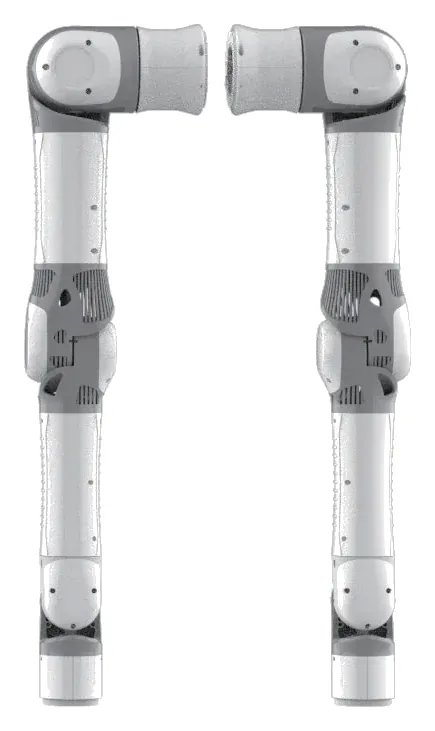
| HRV1 3 kg data-collection arm | Follower — executes the demonstration | 892 mm reach, 4.65 kg per arm, 3 kg payload, RBV1 R48/R58/R68 modules | CANopen / CAN-FD, no brake, no torque sensor |
Specs quoted from manufacturer datasheets; final figures confirmed at quotation.
Which follower arm
The 3 kg data-collection arm is the usual pick for pure capture: RBV1 modules without brakes or torque sensors, 4.65 kg per arm and 892 mm of reach, backdrivable enough to move by hand while you position the station. The force-control versions (3 kg and 15 kg) add a torque sensor and a power-off brake on every axis — worth it when the same arm has to demonstrate contact-rich tasks and then run them without a human in the loop. Compare all three arm versions →
Choosing the leader
A glove is the cheapest way to capture hand DOF, and the only practical one for fingers. A chest-mounted teleoperation arm captures where the wrist and elbow are, which matters when the follower is a 7-DOF arm rather than a hand on a bench. If your policy is trained on end-effector pose, arm plus glove covers both halves of the demonstration. Glove specifications →
FAQ
Do I need torque sensors to capture demonstration data?
Not for pose and trajectory capture — the 3 kg data-collection arm runs RBV1 modules without torque sensors or brakes, which keeps the follower light and cheap per axis. Add sensing when the task outcome depends on force: insertion, wiping, pressing, anything where the demonstration is as much about how hard as where.
Gloves or a teleoperation arm?
A glove captures finger-level motion for hand and gripper tasks and is the fastest way to record 20+ DOF. A chest-mounted teleoperation arm captures whole-arm pose and is the better leader when the follower is an arm. Many teams run both: arm for reach, glove for grasp.
Can you supply a complete capture station?
We supply the hardware layers — leader device, follower arm, end effector — on one purchase order and one shipment. Cameras, workcells and the learning stack stay with you, though we will quote the mounting hardware to drawing.
How accurate is the glove, and what does it output?
The Linker MCG is specified at ≤0.001° resolution with 0.1°/0.2° static accuracy, processing at 600 Hz and outputting at 100 Hz over 2.4 GHz wireless, with 6 h of battery. Both the MCG and FFG ship with the same SDK and ROS packages as the Linker Hand range.