
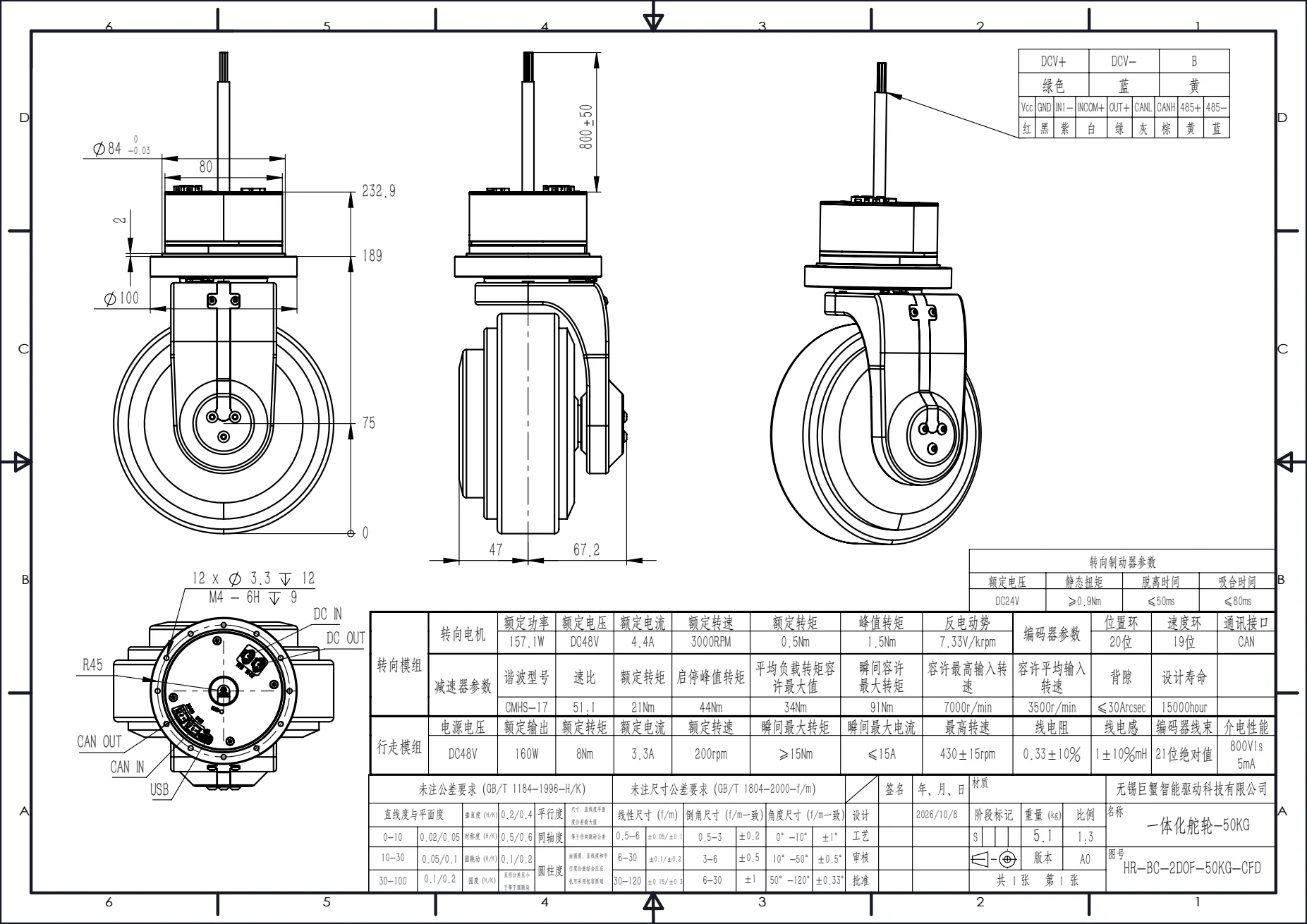
Full specification
| Parameter | Value |
|---|---|
| Steering reducer | CMHS-17 harmonic, 51:1 |
| Steering rated torque | 21 N·m |
| Steering start-stop peak | 44 N·m |
| Steering allowable average (max) | 34 N·m |
| Steering instantaneous max | 91 N·m |
| Steering motor | 157.1 W · DC 48 V · 4.4 A · 3000 rpm |
| Steering motor torque | 0.5 N·m rated / 1.5 N·m peak |
| Steering encoder | 20-bit position loop, 19-bit speed loop |
| Steering brake | DC 24 V · static torque ≥0.9 N·m · release ≤50 ms · engage ≤80 ms |
| Drive motor | 48 V · 160 W · 3.3 A · 200 rpm rated |
| Drive torque | 8 N·m rated · ≥15 N·m instantaneous max |
| Drive speed | 430 ±15 rpm maximum |
| Drive encoder | 21-bit absolute |
| Drive resistance / inductance | 0.33 ±10% Ω / 1 ±10% mH |
| Dielectric strength | 800 V for 1 s, 5 mA |
| Communication | CAN (steering), RS-485 pins on the drive harness |
| Drawing reference | HR-BC-2DOF-50KG-CFD, rev A0, dated 2026-10-08 |
| Weight | Not printed on the manufacturer drawing — confirm at quotation |
Figures verified November 2026 — confirm the exact variant against the datasheet issued with your order.
When this is the right choice
- One assembly, two axes. Steering and traction ship as one bolt-on unit, so there is no steering linkage to design and no separate wheel hub to align.
- Harmonic steering with a real brake. 51:1 in one stage, ≤30 arcsec backlash and a 24 V power-off brake holding ≥0.9 N·m — the wheel holds position when the robot is down.
- Shared drive platform. The 160 W / 8 N·m drive section is the same as the 100 kg class unit, so spares and firmware across the two classes are common.
- Dual encoders on steering (20-bit position, 19-bit speed) and a 21-bit absolute encoder on drive.
When it is the wrong choice
- Weight is not on the drawing. The weight field is blank in the manufacturer sheet — ask for the as-built figure before doing load or stability calculations.
- Load class, not a certified payload. 50KG is the model designation; the drawing does not print a payload test condition. Confirm the rated load and the surface before you size a platform around it.
- 8 N·m drive is modest. For a heavy, fast or inclined platform this wheel is the wrong size even if the steering stage is strong enough.
Alternatives at a similar level
- Crabnova HR-BC-2DOF-100KG — Same 8 N·m drive, but 33 N·m steering and a ≥1.6 N·m brake
- Crabnova RBV3 joint modules — For rotary axes rather than mobile bases
- Crabnova A0/A1/A2 wheeled robots — Complete wheeled platforms if you do not want to build the base
Quote this model
Model, quantity and destination is enough to start — we come back with price, availability and the datasheet.
HR-BC-2DOF-50KG-CFD FAQ
What is the difference between the 50KG and 100KG versions?
The drive section is identical: 48 V, 160 W, 8 N·m rated, 21-bit encoder. Only the steering side changes — 21 N·m rated / 44 N·m peak steering and a ≥0.9 N·m brake on the 50KG, against 33 N·m / 73 N·m and a ≥1.6 N·m brake on the 100KG.
Does it hold its steering angle with power off?
Yes. The steering brake is power-off engaged, DC 24 V, with ≥0.9 N·m static holding torque and ≤50 ms release / ≤80 ms engage times on this model.
What wheel diameter does it use?
The drawing gives the overall envelope and the flange bolt pattern but does not print a separate tyre diameter row. Ask us for the confirmed drawing with the quote.
Can I get the STEP file and wiring pinout?
Yes — both the PDF drawing and the STEP model exist for this model. Ask in the quote form and we send them with the quotation.
Back to Crabnova (Juxiedrive) · integrated wheel modules · need a model that is not listed?