
Full specification
| Parameter | Value |
|---|---|
| Frame / size | Φ100 mm |
| Ratio | 10:1 |
| Rated torque | 40 N·m |
| Rated speed | 120 rpm |
| Peak torque (>3 s) | 170 N·m |
| Peak speed | 192 rpm |
| Weight | 1.35 kg |
| Backlash | 6 arcmin |
| Output bearing | Cross-roller |
| Axial / radial load | 9.2 / 4.1 kN |
| Back-drive torque | 0.8 N·m |
| Supply | 48 V nominal · 12–72 V operating |
| Comms | CAN standard · EtherCAT / CAN FD to order |
| Encoder | Mechanical dual encoder, 14-bit |
| Protection | IP40 · IP54 to order |
| Control modes | Position / speed / torque / force–position hybrid |
| Ambient | −20 to 50 °C · S2 duty |
| Alternative winding | 23 N·m at 150 rpm rated, 100 N·m peak at 280 rpm |
Figures verified November 2026 — confirm the exact variant against the datasheet issued with your order.
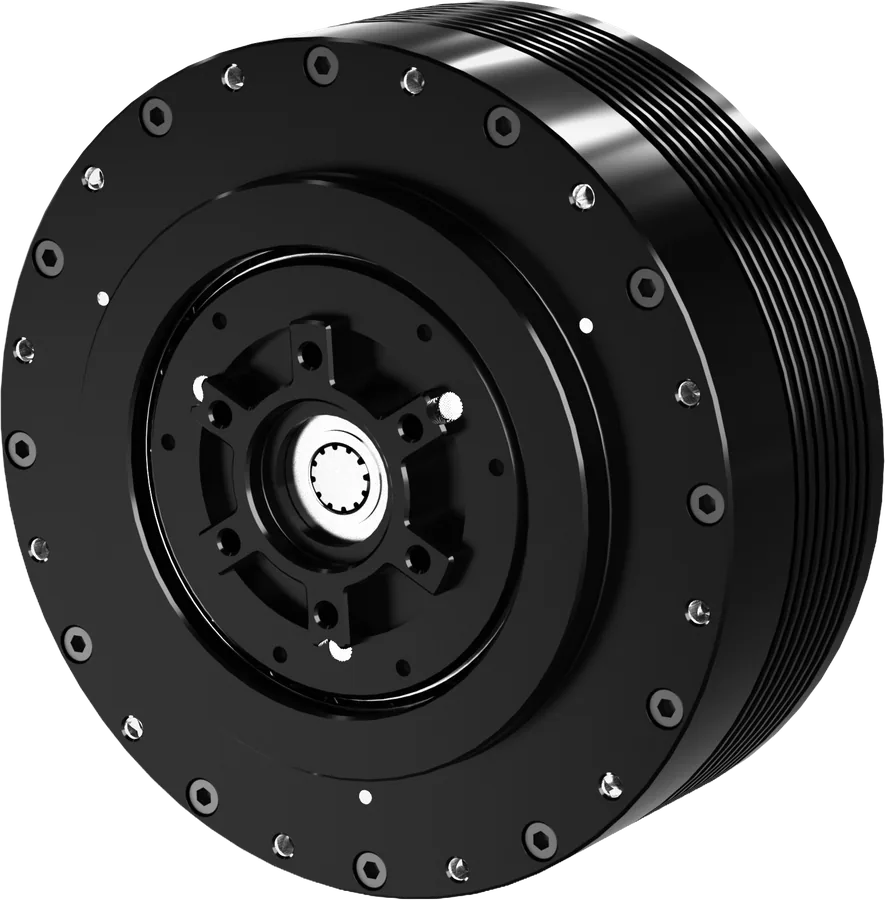
When this is the right choice
- 192 rpm at 170 N·m peak. Wheeled-base and pan-axis torque with genuine speed — and only 6 arcmin of backlash, the tightest in the PA range.
- Shock-tolerant by construction. A planetary stage takes impact loads that a harmonic strain-wave gear resents — one reason leg and wheel axes keep choosing this family.
- Cross-roller output bearing carries 9.2 kN axial / 4.1 kN radial, so the next link hangs off the joint without an extra bearing.
When it is the wrong choice
- Planetary, not harmonic. 6 arcmin of backlash is fine for legs, wheels and pan axes; the wrong pick where the axis must hold position under a reversing load.
- No brake, no hollow bore in the standard build. If the axis must not drop on power loss, this is the wrong family — see the RBV3 alternatives.
Alternatives at a similar level
- Motorevo PA100-20-18 — Same frame wound for torque: 300 N·m peak
- Motorevo PA81-12-18.33 — Lighter fast frame, 90 N·m peak
- EYOU PHU20H-90 — Zero-backlash harmonic at Φ90
Quote this model
Model, quantity and destination is enough to start — we come back with price, availability and the datasheet.
PA100-20-10 FAQ
How much torque does the PA100-20-10 deliver?
40 N·m rated (120 rpm) and 170 N·m peak for bursts over three seconds, at 192 rpm. The figures are catalogue values for the standard winding at 48 V nominal; a second winding gives 23 N·m at 150 rpm rated, 100 N·m peak at 280 rpm.
Does it support a brake, a hollow bore or EtherCAT?
The standard build is CAN only, with no hollow bore and no brake — that is what keeps the mass down. EtherCAT / CAN FD, IP54 and other options differ frame by frame and are confirmed at quotation rather than promised here.
Why do I see two sets of figures for this model?
Two motor windings are offered on the same frame. The table shows the standard winding; the alternative gives 23 N·m at 150 rpm rated, 100 N·m peak at 280 rpm. They are separate order codes, so tell us the duty cycle and we will name the right one on the quotation.
Back to Motorevo · all joint modules · need a model that is not listed?